


Finding the best rated forex brokers in 2026 is not simply a matter of choosing the company with the highest star score. Regulation, trading costs, platforms, account structure, withdrawal rules, customer support and the legal entity holding the account all matter.
That is especially important with forex and CFD brokers because the same brand may operate through several companies in different jurisdictions. A UK client, Australian client and offshore client may receive different leverage limits, complaint routes and regulatory protections even when the trading platform carries the same brand.
This guide therefore treats broker ratings as a research tool rather than a guarantee. Before funding an account, compare the details here with Broker Reviews Hub’s latest forex broker reviews and verify the relevant broker entity directly with its regulator.
Forex and CFD trading involves substantial risk and can result in loss of capital.
How We Define the Best Rated Forex Brokers in 2026
The best rated forex brokers should perform well across several areas rather than relying on one attractive feature.

A broker advertising a very low minimum spread may still charge commissions or overnight financing. A broker with an excellent trading app may operate through an entity that provides fewer retail protections. Another may have strong regulation but a platform that does not fit a particular trading strategy.
Our 2026 comparison framework therefore looks at:
| Rating Factor | Why It Matters | What to Verify |
| Regulation | Determines regulatory oversight and complaint routes | Official regulator register |
| Legal entity | Shows which company holds the account | Broker legal documents |
| Spreads | Major component of trading cost | Typical/average spread, not only minimum |
| Commission | Important on raw-spread accounts | Per-lot or transaction charge |
| Platform | Affects usability and execution workflow | MT4, MT5, TradingView, cTrader, proprietary app |
| Demo account | Lets users practise before funding | Availability and demo limitations |
| Withdrawals | Determines practical access to funds | Methods, KYC, fees and processing rules |
| Support | Important when account problems occur | Contact channels and availability |
| Risk controls | Helps users manage leveraged exposure | Stop-loss, margin warnings and protections |
A broker rating cannot guarantee trading success, future platform reliability or a particular withdrawal outcome. It should narrow the research process, not replace it.
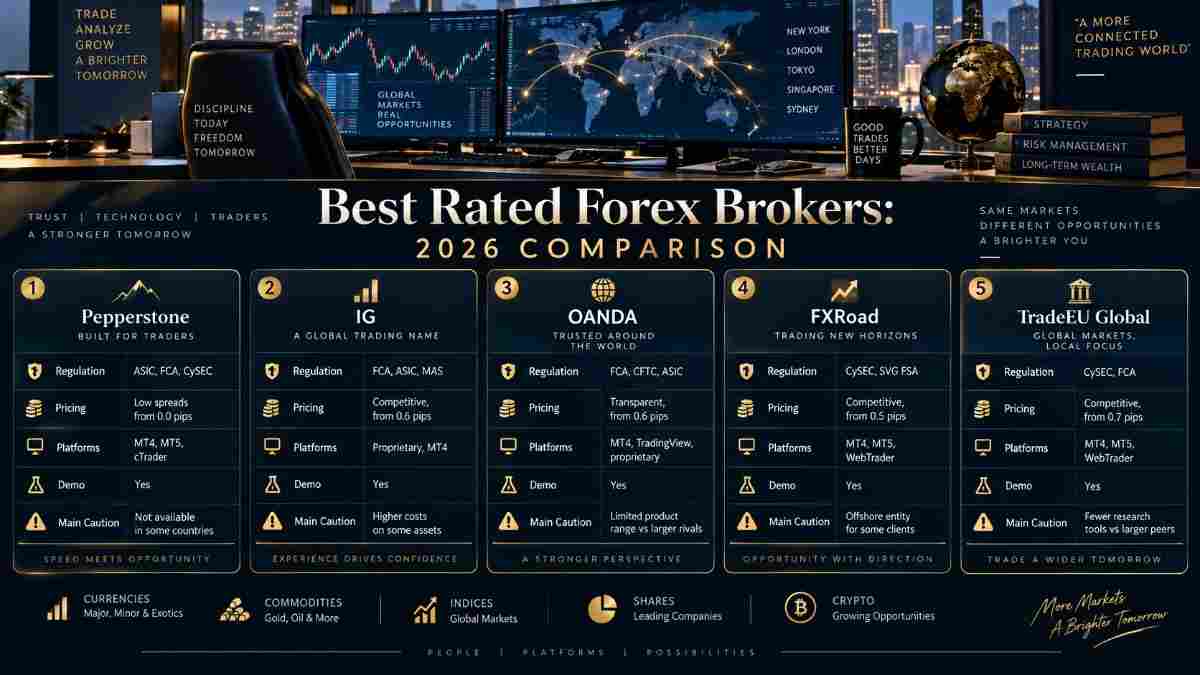
Best Rated Forex Brokers: 2026 Comparison
The following comparison is not a universal ranking. These brokers illustrate different regulatory structures, platform choices and account models. Availability depends on jurisdiction.
| Broker | Regulation / Entity Example | Notable For | Pricing Structure | Platforms | Demo | Main Caution |
| Pepperstone | Pepperstone Ltd, FCA FRN 684312 in UK | Platform choice and Standard/Razor pricing | Spread-only Standard; raw spread + commission Razor | MT4, MT5, cTrader, TradingView, Pepperstone platform | Yes | Entity and protections vary by country |
| IG | IG Markets Ltd, FCA FRN 195355 in UK | Broad platform and market access | Spread/commission structure varies by product | IG web/mobile, MetaTrader options | Yes | Product availability and entity vary by jurisdiction |
| OANDA | OANDA Corp., CFTC-registered RFED and NFA member 0325821 in US | US forex access, TradingView/MT4 integration | Spread/pricing varies by account and region | Web, mobile, TradingView, MT4 in US | Yes | Global OANDA entities have different regulation/products |
| FXRoad | 4Square SY Ltd, Seychelles FSA licence SD052 | Web/mobile CFD trading and virtual account | Spread-based tiered accounts | WebTrader, iOS, Android | Virtual account | Offshore regulation; restricted in several jurisdictions |
| TradeEU Global | Tradesense Holding Ltd, Mauritius FSC licence GB21026906 | Web/mobile CFD platform and tiered accounts | Broker advertises zero trading commissions; spreads vary | WebTrader, mobile app | Virtual account | Mauritius entity; availability restricted in EU, US, Canada and other regions |
Pepperstone’s UK site currently identifies Pepperstone Limited as FCA-authorised under registration number 684312 and offers MT4, MT5, cTrader, TradingView and its own platforms. Its current account material distinguishes Standard pricing from Razor raw-spread plus commission pricing and provides demo access.
IG’s UK documentation identifies IG Markets Ltd as FCA-authorised under register number 195355. IG also provides demo trading and supports its own web/mobile environment alongside MetaTrader options, although the exact platforms and products depend on the entity and account.
For US forex customers, OANDA Corporation states that it is registered with the CFTC as a Futures Commission Merchant and Retail Foreign Exchange Dealer and is an NFA member under number 0325821. OANDA’s US platform supports web/mobile trading, TradingView and MT4, with demo accounts available. Its own regulatory disclosure also shows that the OANDA group operates through different regulated entities internationally.
FXRoad’s legal page says it is operated by 4Square SY Ltd and licensed by the Seychelles FSA under SD052. Its current account pages list Silver, Gold, Platinum and Islamic accounts, while its FAQ lists a €250 minimum deposit and a virtual account. Its website also states that it does not offer services to residents of several jurisdictions, including the US, Canada and EU. Readers considering it can examine the full FXRoad review before proceeding.
TradeEU Global’s official site identifies Tradesense Holding Ltd as a Mauritius company regulated by the Mauritius FSC under licence GB21026906. It advertises Silver, Gold, Platinum and Islamic accounts, WebTrader/mobile access and a virtual account, but its own legal notice excludes residents of the EU, US, Canada and several other jurisdictions. Broker Reviews Hub provides a more detailed TradeEU Global review.
Best Forex Brokers for Beginners: What Actually Matters?
The best forex broker for beginners is not automatically the broker offering the highest leverage or the smallest advertised spread.

A new trader needs an environment where mistakes can be practised without immediate financial consequences. Demo access is therefore one of the first features to check. Pepperstone, IG, OANDA, FXRoad and TradeEU Global all currently provide some form of demo or virtual trading environment.
Beginners should prioritise:
- demo trading,
- understandable order controls,
- stop-loss and take-profit functions,
- transparent pricing,
- small position sizes,
- educational material,
- responsive support,
- clear margin information,
- straightforward withdrawal terms.
A demo still has limitations. IG, for example, explains that demo trades may not experience slippage, interest adjustments or some of the execution conditions present in a live account. Pepperstone similarly states that demo pricing and execution may differ from live trading.
Beginners can also review Broker Reviews Hub’s guide to the top forex trading platforms for beginners and its discussion of the best major currency pairs for small forex accounts.
Beginner Red Flags
Be cautious when a broker or salesperson emphasises very high leverage as an easy route to larger profits. Leverage magnifies losses as well as gains.
Other warning signs include aggressive calls, pressure to increase deposits, unclear company information, no demo facility, confusing fees, bonus conditions that affect withdrawals and missing regulator details.
Best Regulated Forex Brokers: Verify the Entity, Not Just the Logo
Searching for the best regulated forex brokers requires more than seeing a regulator logo at the bottom of a broker website.
In the UK, traders can use the FCA Firm Checker or Financial Services Register. The FCA says users should check that a company is authorised and has permission for the specific service it offers. It also warns about clone firms that copy the identity of legitimate companies.
US users can check forex firms and professionals through NFA BASIC. NFA describes BASIC as a database containing CFTC registration, NFA membership, disciplinary and financial information for retail forex and futures firms.
Australian users can use the ASIC Professional Registers, while EU users checking a Cyprus investment firm can use the CySEC investment-firm directory.
Why the Legal Entity Matters
The brand name is not enough.
OANDA is a good example. Its US business is OANDA Corporation under CFTC/NFA oversight, while its disclosure lists different regulated companies for the UK, Australia, Singapore, Canada and other markets.
Pepperstone follows a similar entity-based structure. Its UK website explicitly states that UK services are provided through FCA-regulated Pepperstone Limited.
The protections attached to one entity should therefore never be automatically attributed to every customer of the global brand.
Best Forex Brokers for Low Spreads
Many traders search for the best forex brokers for low spreads, particularly scalpers and frequent traders. But minimum spread is only the starting point.
A broker may advertise spreads “from 0.0 pips,” yet that price may apply only under particular market conditions and may come with a per-lot commission.
Pepperstone illustrates the difference. Its Standard account incorporates most trading fees into the spread, while the Razor account uses raw spreads plus commission on forex and certain other instruments.
FXRoad uses a different model. Its current account page advertises spreads starting around 2.4 pips on Silver, 1.8 on Gold and 1.2 on Platinum, while leverage can reach 1:200 under that Seychelles entity.
Neither structure is automatically cheaper. Total cost depends on the instrument, trading frequency and account.
Before comparing “low spread” brokers, calculate:
- spread,
- commission,
- overnight swap or financing,
- currency conversion,
- slippage,
- withdrawal charges,
- inactivity charges,
- any account-specific markup.
Broker Reviews Hub’s explainer on what FX fees are gives useful context.
ECN vs STP Pricing
Labels such as ECN, STP and raw spread can be confusing because brokers may use different execution and pricing structures.
Raw or ECN-style accounts often advertise tighter spreads but add commission. Spread-based accounts bundle more of the cost into the quoted spread.
The better comparison is therefore total trading cost rather than the account label alone. The guide to ECN vs STP forex accounts explains these differences in more detail.
Trading Platforms to Compare
The best trading brokers should provide platforms that match the trader’s workflow rather than simply offering the longest feature list.
Common choices include:
- MetaTrader 4,
- MetaTrader 5,
- TradingView,
- cTrader,
- proprietary browser platforms,
- Android and iOS trading apps.
Pepperstone currently offers one of the broader platform menus among this comparison set, with MT4, MT5, cTrader, TradingView and its proprietary platform.
OANDA’s US platform supports its web/mobile environment, TradingView and MT4. FXRoad and TradeEU Global concentrate more heavily on proprietary WebTrader and mobile interfaces.
Platform quality should be judged through order controls, charting, margin visibility, alerts, account history, stability and ease of withdrawals—not just appearance.
How to Read Forex Broker Reviews Before Depositing
Good forex broker reviews should answer questions that matter after registration, not simply describe the homepage.
A useful review should identify:
- operating company,
- regulator and licence,
- platforms,
- account types,
- spreads and commissions,
- deposits,
- withdrawal process,
- leverage,
- customer support,
- restrictions,
- risk disclosures,
- meaningful complaints.
The best reviews also separate broker claims from independently verified information.
A review that uses only positive adjectives, promises returns, ignores withdrawal conditions or does not identify the legal entity should carry little weight.
Broker Account Types: Standard, Raw Spread, ECN and Demo
Standard accounts are generally simpler because trading cost is commonly included in the spread. Raw-spread or ECN-style accounts may appeal to higher-volume traders because quoted spreads can be tighter, but commissions become more important.
Demo accounts are useful for platform testing, but they cannot perfectly reproduce live execution.
Some brokers also offer Islamic or swap-free accounts. These require additional checking because “swap-free” does not always mean completely free of overnight or administrative charges. Read the actual holding-period and fee rules rather than relying on the account name.
Deposit and Withdrawal Checks
Withdrawal transparency should be a major part of any best-broker comparison.
Before depositing, check:
- minimum funding amount,
- accepted payment methods,
- whether withdrawals must return to the original funding method,
- expected processing period,
- KYC requirements,
- bank/payment-provider fees,
- currency-conversion charges,
- dormant-account rules.
FXRoad, for example, currently states that withdrawals are processed by the broker within three business days, followed by an estimated five to seven business days for funds to appear after approval. It says its minimum bank-wire withdrawal is €50 and that external bank/payment-provider charges may still apply.
Those are broker-published terms, not a guarantee of an individual withdrawal timeline. Users should save copies of the terms applicable when they deposit.
Forex Broker Red Flags to Avoid in 2026
The FCA continues to warn consumers about forex trading scams, including firms that falsely claim UK authorisation. It recommends checking the official Firm Checker rather than trusting licence claims supplied by the broker itself.
Watch for:
- no identifiable legal entity,
- unverifiable licence number,
- guaranteed returns,
- “risk-free” forex claims,
- pressure to deposit immediately,
- aggressive account managers,
- repeated explanations for delayed withdrawals,
- restrictive bonus terms,
- clone-firm contact details,
- crypto-only funding with no clear reason,
- no meaningful risk disclosure.
Regulation does not eliminate trading risk, but inability to verify the firm significantly increases uncertainty.
How to Choose a Broker for Your Trading Style
Different traders need different features.
Beginners should focus on demo access, straightforward fees, educational tools, risk controls and useful customer support.
Active traders should examine average spreads, commissions, execution quality, slippage, platform reliability and VPS/API options where needed.
Longer-term CFD traders should pay close attention to overnight financing because these costs can accumulate.
Mobile traders should test app stability, alerts, biometric security, order modification and account-management functions.
Cost-sensitive traders should calculate total trading cost instead of choosing the broker displaying the smallest minimum spread.
Final Checklist Before Choosing a Forex Broker
Before opening a live account, confirm:
- the exact legal entity,
- regulation through the regulator’s own register,
- jurisdiction applying to your account,
- spreads and commissions,
- overnight charges,
- account and leverage rules,
- demo availability,
- platform suitability,
- deposit methods,
- withdrawal terms,
- customer-support channels,
- complaint procedure,
- risk disclosures.
Do not deposit simply because a broker appears on a list of top rated forex brokers. The purpose of a comparison is to identify what requires further verification.
Final Thoughts
The best rated forex brokers in 2026 should be evaluated through regulation, transparency, platforms, fees, account conditions, customer support and withdrawal procedures.
Pepperstone, IG and OANDA demonstrate how established brands can operate through clearly identified regulated entities, but customers still need to verify the specific entity available in their country. FXRoad and TradeEU Global also publish identifiable companies and regulatory information, but their Seychelles and Mauritius structures respectively require readers to understand the different level and jurisdiction of oversight before funding an account.
There is no universal best forex broker for every trader. A beginner may prioritise demo trading and education, while an active trader may care more about execution and total transaction cost.
Use Broker Reviews Hub’s individual forex broker reviews to investigate a broker in more depth, then verify the legal entity and regulation independently before opening a live account.
Disclaimer
This article is for educational and informational purposes only. It does not provide financial, investment, trading, legal or tax advice. Forex and CFD trading involve significant risk and may result in loss of capital. Broker regulation, fees, leverage, spreads, platforms and account protections vary by jurisdiction and may change over time. Always verify a broker’s legal entity, official regulatory status, terms, fees and risk disclosures before opening or funding a trading account.
FAQs
What are the best rated forex brokers in 2026?
The best rated forex brokers should be compared through regulation, spreads, commissions, platform quality, account types, withdrawal terms and support. There is no single broker that is best for every jurisdiction or trading style.
What is the best forex broker for beginners?
A beginner-friendly broker should provide demo trading, understandable platforms, clear fees, educational resources, small position sizes, responsive support and strong risk controls rather than simply high leverage.
How do I check if a forex broker is regulated?
Find the broker’s exact legal entity and licence number, then search the official regulator database. UK traders can use the FCA Firm Checker, US traders can use NFA BASIC, and other jurisdictions have their own official registers.
Are low-spread forex brokers always better?
No. Compare commission, average spread, swaps, slippage, currency conversion, deposit and withdrawal costs as well as the advertised minimum spread.
What should I look for in forex broker reviews?
Look for the operating company, regulation, platforms, account types, fees, leverage, deposits, withdrawals, complaints, customer support and balanced risk discussion.
Are regulated forex brokers risk-free?
No. Regulation provides oversight and may provide specific protections, but it cannot remove forex or CFD market risk.
What is the safest way to test a forex broker?
Start by verifying its regulation and legal entity, then use a demo account to test the interface and order controls. Read the live-account fees and withdrawal conditions separately because demo conditions can differ from real trading.
Which forex broker is best for low spreads?
There is no universal answer. Compare average spreads and commissions together. A raw-spread broker may show very low quoted spreads but charge a per-lot commission, while a Standard account may incorporate more of the cost into the spread.


