


Selecting an appropriate forex account can be as significant a decision as selecting a suitable trading strategy. While many traders pay attention exclusively to spreads and leverage, they frequently overlook such trading costs as those related to specific account types.
ECN (Electronic Communication Network) and STP (Straight Through Processing) accounts are the two most widespread forex account types among forex brokers. Though they give you access to the forex market, their approaches to spreads, commissions, orders execution, and other trading costs vary.
While there are many beginners who consider ECN accounts to be cheaper due to their tight spreads, there are many others who think that STP accounts are the right choice as they offer commission-free trading. Neither account type is cheaper than the other one. It all depends on how your broker makes his profit.
This article describes the differences between ECN and STP forex accounts and helps you make the right decision based on these differences.
What Is an ECN Account?
An ECN (Electronic Communication Network) account is an account where a trader accesses liquidity providers such as banks, hedge funds, and other financial institutions.
The broker does not establish his own rates; he just connects traders to the existing buy/sell orders in the market.
Prices are offered by liquidity providers; therefore, an ECN account always has:
- Very tight spreads
- Fast execution
- High transparency
- Separate commission charges
The broker mainly earns money through commissions rather than increasing spreads.
Main Features of ECN Accounts
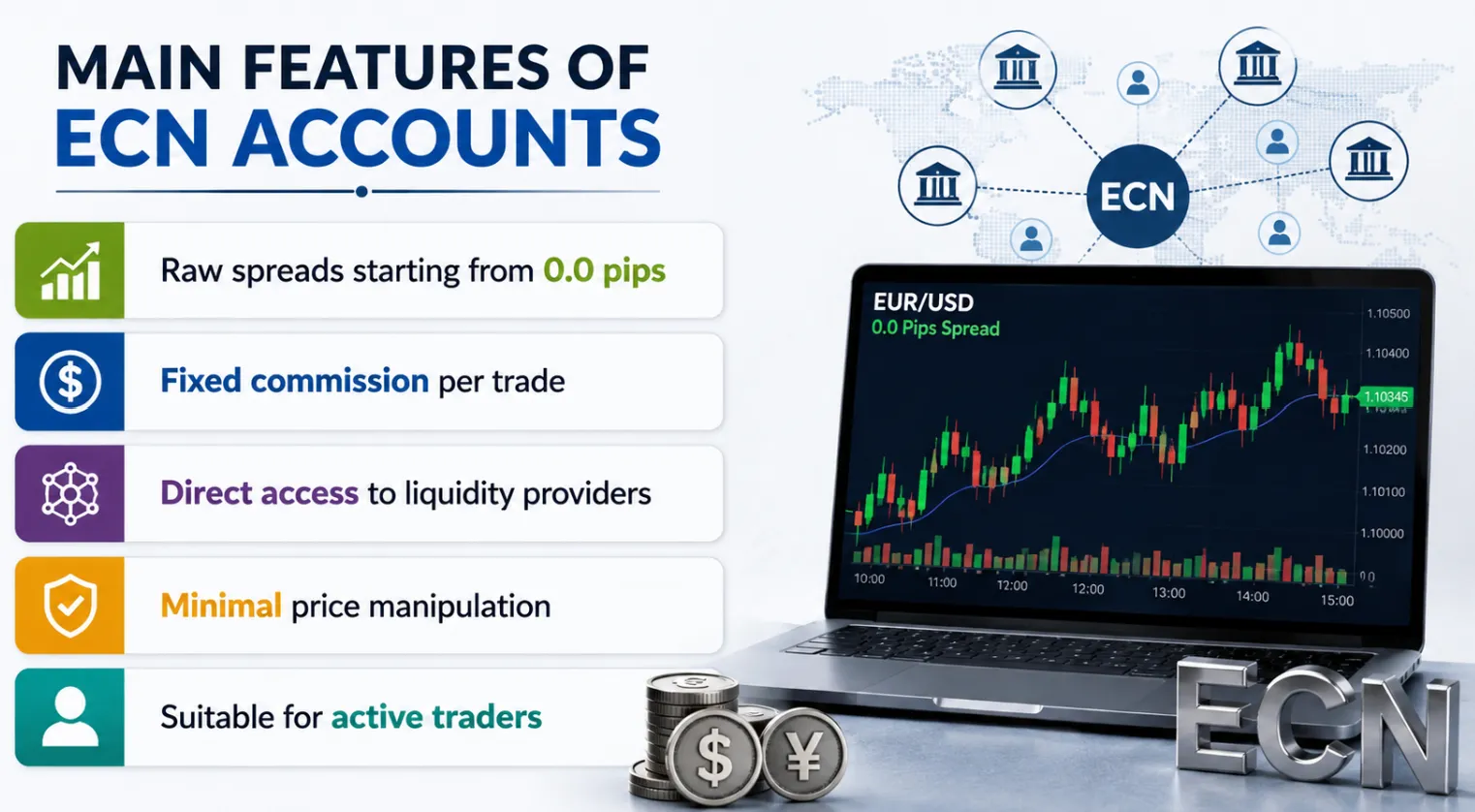

- Raw spreads starting from 0.0 pips
- Fixed commission per trade
- Direct access to liquidity providers
- Minimal price manipulation
- Suitable for active traders
What Is an STP Account?
STP (Straight Through Processing) account also forwards client orders to liquidity providers without the need for dealing desk intervention.
Nevertheless, unlike ECN accounts, the broker typically includes a small markup in the spread before offering prices to traders.
Commissions are not usually charged by STP brokers; rather, they make money from the spread markup..
Main Features of STP Accounts
- No separate commission in many cases
- Slightly wider spreads
- Fast order execution
- Simple pricing model
- Beginner-friendly
ECN vs STP Account: Quick Comparison
| Feature | ECN Account | STP Account |
| Spread | Raw spreads | Marked-up spreads |
| Commission | Yes | Usually No |
| Market Access | Direct liquidity | Liquidity providers through broker |
| Pricing | Transparent | Broker markup included |
| Best For | Active traders | Beginners and casual traders |
How ECN Brokers Make Money
Many traders wonder why ECN brokers charge commissions.
The answer is simple.
Instead of increasing spreads, ECN brokers charge a fixed commission on every trade.
For example:
- Raw spread: 0.1 pip
- Commission: $7 per lot (round trip)
The broker earns only from the commission.
This model is generally considered more transparent because traders can clearly see what they are paying.
ECN Broker Commission Cost Breakdown
Let’s look at a simple example.
Suppose EUR/USD has:
- Raw spread: 0.2 pip
- Commission: $7 per standard lot
Cost calculation:
Spread Cost
0.2 pip × $10 = $2
Commission
$7
Total Trading Cost
$2 + $7 = $9 per lot
Although the spread is very small, the commission increases the total trading cost.
How STP Brokers Make Money
STP brokers usually do not charge a commission.
Instead, they increase the spread slightly before showing prices to traders.
For example:
Actual market spread:
0.4 pip
Broker markup:
0.8 pip
Displayed spread:
1.2 pips
The broker keeps the extra 0.8 pip as profit.
This pricing model is simple because traders only pay the spread.
STP Broker Spread Markup Explained
Many traders think commission-free trading means free trading.
That is not true.
The commission is simply hidden inside the spread.
Example:
Market spread:
0.5 pip
Broker markup:
0.7 pip
Final spread:
1.2 pips
The trader pays:
1.2 pip × $10
= $12 per standard lot
There is no commission, but the overall cost may actually be higher than an ECN account.
Hidden Markup vs Visible Commission
This is one of the biggest differences between ECN and STP accounts.
ECN Pricing
- Raw spread shown
- Commission shown separately
- High transparency
STP Pricing
- Commission hidden
- Spread includes broker profit
- Easier for beginners to understand
Neither model is automatically better.
The total cost depends on the broker’s pricing.
Direct Market Access vs Straight Through Processing
This is another common question among forex traders.
Direct Market Access (DMA)
Direct Market Access allows traders to interact directly with available market prices from liquidity providers.
ECN brokers are usually associated with DMA because they display raw prices without major changes.
Advantages include:
- Better transparency
- Faster execution
- Market-based pricing
Straight Through Processing (STP)
STP brokers also send orders electronically to liquidity providers.
However, they usually choose the best available price after applying their own spread markup.
Advantages include:
- Easy pricing
- No separate commissions
- Good for beginners
Although both avoid dealing desks in most cases, ECN generally offers greater pricing transparency.
Difference Between True ECN and STP Broker
Many brokers advertise themselves as ECN brokers even when they actually operate like STP brokers.
Here are the major differences.
True ECN Broker
- Offers raw spreads
- Charges fixed commissions
- Connects directly to multiple liquidity providers
- High pricing transparency
- No spread manipulation
STP Broker
- Adds spread markup
- May not charge commission
- Routes orders through liquidity providers
- Simpler pricing model
- Broker earns from spread
Always check the broker’s pricing details before opening an account.
Which Account Has Lower Trading Costs?
The answer depends on your trading style.
Example 1
ECN Account
Spread:
0.2 pip
Commission:
$7
Total Cost:
Around $9
STP Account
Spread:
1.2 pips
Commission:
None
Total Cost:
Around $12
In this example, the ECN account is cheaper.
Example 2
ECN Account
Spread:
0.8 pip
Commission:
$8
Total Cost:
Around $16
STP Account
Spread:
1.1 pip
Commission:
None
Total Cost:
Around $11
In this example, the STP account is cheaper.
This is why traders should compare total costs rather than only spreads or commissions.
Which Account Is Better for Scalping?
Scalpers open many trades every day.
They need:
- Lowest possible spreads
- Fast execution
- Small slippage
Because of these requirements, ECN accounts are generally preferred for scalping.
Even after paying commissions, the overall trading cost is often lower.
Which Account Is Better for Swing Trading?
Swing traders usually hold positions for several days.
Since they place fewer trades, slightly higher spreads may not have a major impact.
Many swing traders prefer STP accounts because:
- No commission
- Simple pricing
- Easy trade management
Which Account Is Better for Beginners?
Many new traders prefer STP accounts because the pricing is easier to understand.
Advantages include:
- No commission calculations
- Simple cost structure
- Easy account management
However, beginners should still compare spreads because some brokers charge large markups.
Which Account Is Better for Professional Traders?
Professional traders usually focus on:
- Low spreads
- Fast execution
- Large trading volumes
- Cost efficiency
For these reasons, many professionals prefer ECN accounts despite paying commissions.
Advantages of ECN Accounts
Transparent Pricing
Traders know exactly how much commission they pay.
Lower Raw Spreads
Spreads often start from 0.0 pips.
Faster Execution
Orders are matched quickly through liquidity providers.
Better for Active Trading
Ideal for scalping, news trading, and algorithmic trading.
Disadvantages of ECN Accounts
- Commission on every trade
- Higher minimum deposits with some brokers
- More complex pricing for beginners
Advantages of STP Accounts
Simple Pricing
Everything is included in the spread.
No Commission
Most STP accounts do not charge separate commissions.
Beginner Friendly
Easy to understand total trading costs.
Lower Entry Requirements
Many brokers allow small deposits.
Disadvantages of STP Accounts
- Wider spreads
- Hidden broker markup
- Less pricing transparency
- Costs can become high during volatile markets
How to Compare ECN and STP Brokers
Before choosing a broker, compare these factors:
Spread
Check the average spread instead of the advertised minimum.
Commission
Calculate the total commission per standard lot.
Execution Speed
Fast execution reduces slippage.
Liquidity Providers
More liquidity providers usually result in better pricing.
Trading Style
Choose an account that matches how often you trade.
Common Myths About ECN and STP Accounts
Myth 1: ECN Is Always Cheaper
Not always.
High commissions can sometimes make ECN accounts more expensive than STP accounts.
Myth 2: STP Brokers Are Market Makers
Not necessarily.
Many STP brokers genuinely pass orders to liquidity providers.
Myth 3: Commission-Free Means Free Trading
False.
The broker usually earns through spread markups.
Myth 4: Raw Spreads Mean Zero Trading Cost
Even with raw spreads, commissions still apply.
Tips for Choosing the Right Account
When comparing ECN and STP accounts:
- Calculate the total trading cost per trade.
- Compare average spreads, not minimum spreads.
- Check commission rates carefully.
- Test execution speed using a demo account.
- Read the broker’s pricing policy before opening an account.
- Choose the account that matches your trading strategy rather than marketing claims.
Final Thoughts
In conclusion, there is no definite winner of the battle between the two types of accounts as they target different kinds of traders.
With an ECN account, one receives raw spreads, clear prices and market access but commissions are charged separately from the spread, hence making it appropriate for scalpers, day traders and high volume professionals.
STP account makes the transaction easy since the commission is incorporated into the spread and is not charged separately; although at times trading becomes too costly because of the hidden spread markups. STP accounts are recommended for beginners and low volume traders.
In order to avoid being misled by advertising, it is advisable to look into the total cost of trading, execution speed, average spreads and commission structure. It will be important to know the difference between ECN and STP brokers, as well as understand the ECN broker commission cost breakdowns and STP broker spread markups.
FAQs
1. What is the main difference between an ECN and STP account?
The main difference is pricing. ECN accounts offer raw spreads and charge a separate commission, while STP accounts usually include the broker’s fee within the spread and often do not charge a separate commission.
2. Which is better: an ECN or STP account?
It depends on your trading style. ECN accounts are generally better for scalpers and active traders because of tighter spreads, while STP accounts are often more suitable for beginners and swing traders due to their simple pricing structure.
3. Do ECN brokers always charge commissions?
Yes, most true ECN brokers charge a commission for each trade because they provide raw market spreads and earn revenue through commissions instead of spread markups.
4. Are STP brokers commission-free?
Many STP brokers do not charge a separate commission, but they usually earn money by adding a markup to the spread. This means the trading cost is included in the spread rather than shown separately.
5. How can I identify a true ECN broker?
A true ECN broker typically offers raw spreads, transparent commission fees, direct access to multiple liquidity providers, and does not make money by increasing spreads. Always review the broker’s pricing policy before opening an account.
6. Which account type has lower trading costs?
Neither account type is always cheaper. The total trading cost depends on the combination of spreads, commissions, and your trading frequency. Comparing the overall cost per trade is the best way to determine which account offers better value.